
Gothic 1 Remake – Classic RPG Reimagined for Modern PC Hardware
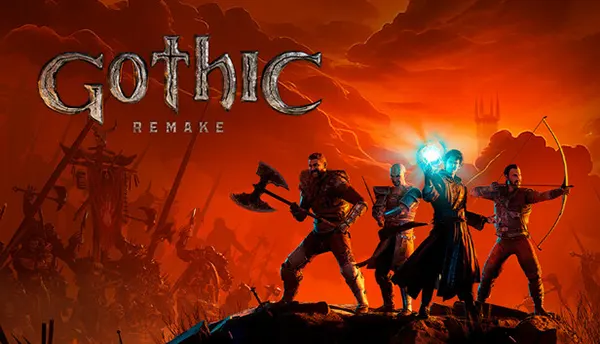
More than two decades after its original release in 2001, Gothic returns in a fully rebuilt form designed specifically for contemporary PC hardware. Developed by Alkimia Interactive and published by THQ Nordic, Gothic 1 Remake is not a simple visual remaster but a ground-up recreation in Unreal Engine 5. As of 2026, the project stands as one of the most closely watched RPG revivals, aiming to preserve the uncompromising spirit of the original while aligning it with current technical standards and player expectations.
A Faithful Reconstruction of the Valley of Mines
The original Gothic was known for its harsh world design, reactive factions, and an unforgiving progression system. The remake retains the same setting — the penal colony within the magical barrier — but reconstructs the Valley of Mines with significantly greater environmental density. Terrain geometry, lighting, vegetation systems, and vertical level design have all been expanded using modern rendering techniques available in Unreal Engine 5, including Nanite and Lumen technologies.
Unlike many modern RPGs that rely on procedural generation, Gothic 1 Remake continues to prioritise handcrafted world-building. Camps such as the Old Camp, New Camp, and Sect Camp are being recreated with additional architectural detail, improved NPC routines, and more nuanced environmental storytelling. Early gameplay showcases released between 2024 and 2025 confirmed that the developers are maintaining the oppressive atmosphere and social hierarchy that defined the original.
Importantly, the world scale has not been artificially inflated. Instead of increasing map size for spectacle, the focus remains on depth and interactivity. Wildlife behaviour, ambient conversations, and day-night activity cycles have been modernised without sacrificing the tight, interconnected world structure that made the 2001 release distinctive.
Modern Visual and Technical Standards
Running on Unreal Engine 5, the remake introduces physically based rendering, dynamic global illumination, and high-resolution texture streaming. Character models have been completely rebuilt, featuring facial animation systems suitable for contemporary dialogue presentation. Armour and weapon models now reflect material properties accurately, including metal roughness and fabric deformation.
On PC hardware available in 2026, the game supports scalable performance profiles. High-end systems benefit from ray-traced lighting and advanced shadow systems, while mid-range configurations can rely on optimised Lumen-based lighting without hardware ray tracing. DLSS, FSR, and XeSS upscaling technologies are supported, allowing stable performance at higher resolutions.
Loading architecture has also evolved. With NVMe SSD support as a baseline expectation in modern gaming PCs, area transitions are virtually seamless. This preserves immersion and removes technical limitations that affected the original release on early-2000s hardware.
Combat, Controls, and Gameplay Systems Reworked
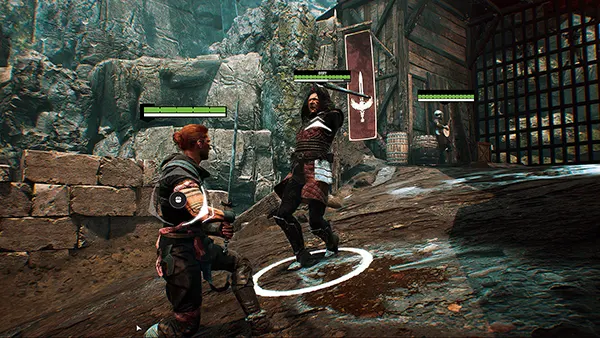
One of the most debated aspects of the original Gothic was its control scheme. The remake addresses this directly by redesigning combat input while keeping its deliberate pacing. Instead of rigid directional attack combinations tied to keyboard timing, the new system introduces a hybrid model that blends stamina management, positional combat, and readable enemy animations.
Melee combat now includes clearer telegraphing, parry windows, and improved hit detection. However, it does not transform into a fast, arcade-style action system. The intention is to preserve the grounded, weighty feel that required commitment to each strike. Magic systems are being expanded with improved visual feedback and spell impact clarity, without changing their narrative role in the colony’s power structure.
Character progression remains skill-based rather than level-gated. Players still invest learning points with trainers, reinforcing Gothic’s identity as a world where knowledge must be earned socially rather than unlocked automatically through menus.
Faction Identity and Narrative Structure
The faction-driven narrative is one of Gothic’s defining pillars, and the remake preserves this structure. Joining a camp significantly alters quest availability, dialogue tone, and character relationships. Early developer updates have confirmed expanded dialogue trees and additional side content, but without altering the core storyline established in the original script.
NPC behaviour systems have been modernised using more advanced AI routines. Characters now react more dynamically to player actions, including theft, combat reputation, and faction alignment. However, the game avoids the trend of over-scripting every interaction; unpredictability remains part of its identity.
The protagonist remains a nameless convict whose identity is shaped entirely by player decisions. This grounded narrative approach contrasts with modern RPGs that often centre around pre-defined heroic arcs. Gothic 1 Remake maintains its rough, survival-focused tone, ensuring continuity with the source material.
Positioning in the 2026 RPG Landscape
By 2026, the RPG genre on PC includes large-scale open worlds such as Baldur’s Gate 3, Elden Ring expansions, and upcoming Unreal Engine 5-powered fantasy titles. Gothic 1 Remake does not attempt to compete through sheer scale. Instead, it positions itself as a focused, systems-driven experience with a compact but dense world.
What distinguishes the remake is its refusal to simplify progression systems. There are no intrusive quest markers guiding every step, and exploration still requires attention to dialogue and environmental cues. This design philosophy appeals to players seeking a structured but demanding RPG rather than a streamlined cinematic experience.
Community feedback during development has played a substantial role in shaping the project. Following mixed reactions to the 2019 playable teaser, THQ Nordic established Alkimia Interactive as a dedicated studio for the remake. Since then, development updates have demonstrated a stronger commitment to authenticity and technical transparency.
Hardware Requirements and PC Optimisation in 2026
As of 2026, the expected system requirements reflect current industry standards. A mid-range gaming PC with a modern six-core CPU, 16 GB of RAM, and a GPU equivalent to an RTX 3060 or RX 6700 XT is sufficient for high settings at 1080p. Higher resolutions and ray-traced effects require GPUs from the RTX 40-series or RDNA 3 generation.
Unreal Engine 5 optimisation has improved significantly compared to its early implementations in 2022–2023. Gothic 1 Remake benefits from refined shader compilation pipelines and better CPU thread management, reducing stutter during traversal.
Crucially, the developers have confirmed modding considerations for the PC version. While not identical to the original’s community-driven mod scene, the remake is designed with extensibility in mind, ensuring that Gothic’s long-standing PC heritage continues into a new technological era.